


After 30 years in Wealth Management advising CEO’s of Public and Private companies, billionaires, founders, innovators, and entrepreneurs, many of whom built the very technologies changing the world, I became obsessed with a simple question:
“Why hasn’t our own industry evolved at the same pace as the people we advise?”
I’ve been surrounded by the kinds of founders who bend reality. I’ve sat with people building AI that decodes DNA, neural nets that seemed to think for themselves, spaceships and rockets that altered humanity, Chips that ushered in a Fourth Industrial Revolution, and networks that rewire how humans connect.
Yet, while they reinvented their worlds, ours stood still. My own industry — the one entrusted with managing their futures — stayed stuck in the past. How ironic?
One client, one advisor, one meeting at a time. It was like watching electric cars reinvent transportation while our industry kept shoeing the horses. I couldn’t sit still….
I’ve Seen This Movie Before
By 2015, many of us could see the cracks forming in the wealth-management establishment. The big-bank model was collapsing under its own weight — conflicts of interest, bureaucracy, zero innovation. We knew something had to change.
That’s why I launched www.Intellect.us, to build an independent model aligned with clients — who just happened to be the people creating the future. That first revolution, the rise of the RIA, was about liberation: not so much for us, but for them. Along with our partners, we shifted the ground under the industry, finally sitting on the same side of the table as our clients and removing institutional rot from the equation.
And it worked. The industry followed. We proved independence wasn’t just possible — it was inevitable. Today the RIA space manages over $144 trillion. The first wave of disruption succeeded.
But, wealth management today is deeply underinvested in technology, largely operating the same way it did at the turn of the millennium. The large banks have ignored investing for their clients altogether even though they have the balance sheets and ability to do so. And in spite of the massive growth in the RIA sector, it still operates much like a craft business — rooted in personal service, but stretched by growth expectations it was never tooled to handle, operating as if it were going to be able to have one on one meetings with every client forever. The entire Wealth Industry largely has acted as if it were immune to the digital transformation and innovation reshaping every other sector. Many of the first time founders struggle with the challenges of running their own business and thus aren’t trying to scale; they’re simply farming cash flow. Many of the more successful firms that left the wirehouses to chase freedom found out quickly that independence came with its own set of handcuffs — compliance, operations, tech fragmentation and silo’s. It wasn’t lack of vision; it was lack of infrastructure. We built firms that our clients loved — but behind the scenes, we were duct-taping systems together and grinding through work that technology should have been doing for us
This inertia has consequences. It’s why the banks have failed so completely at wealth management. When was the last time a major bank brought anything remotely innovative to its clients? Their client portals remain static, sterile spreadsheets…places where data goes to die. The independent RIA movement was supposed to fix that—to deliver freedom, transparency, and alignment. And it has. But independence without innovation is just isolation. Too many RIAs stopped building once they broke away. And while the independent RIA movement has rightfully taken massive share from these institutions, it’s delivery of technology solutions and any form of innovation is absent. The RIA space and Advisory more broadly now face their own crossroads.
RIAs are better on philosophy and service, but they’re rarely technologists. They’ve built better client outcomes but not scalable experiences. They lack the tools to translate their empathy and insight into consistent, digital-first engagement. The very things that make them special—time, touch, trust, expertise don’t scale and that lack of focus on innovation will prove to be a significant barrier to growth. So, technology must step in and Artificial Intelligence is the solution! It is the first platform that can accelerate the evolution of the human advisory experience itself.
This simple question kept repeating in my brain:
“Why hasn’t our own industry evolved at the same pace as the people we advise?”
The Truth We All Quietly Know: The Engagement Gap Is Our Greatest Opportunity
Wealth management today is groaning under the legacy of its own architecture. The very structures that once gave us stability — one-on-one meetings, quarterly reviews, rigid workflows, now limit our reach. The deep, personal conversations that define our work also create a bottleneck no amount of effort or scheduling can solve.
For years, our instinct has been to hire our way out of it, but in today’s digital world, that’s not a scalable answer. And for many independent firms, investing in technology that could expand capacity feels daunting. Many firms are lean teams wearing too many hats, serving clients that they care about deeply, but always in the weeds. There’s only so much time in a day, and yet expectations keep multiplying.
But the next generation won’t wait for us to catch up.
Consider this:
There’s a $124 trillion wealth transfer underway — from Boomers to digital natives.
Over 80% of younger high-net-worth clients are comfortable with AI-driven experiences, and nearly 60% prefer hybrid AI–human models.
The industry faces a shortage of 100,000+ advisors by 2034 — and it’s not easy to find, train, or retain great talent.
Even the best advisors can effectively serve 50–100 clients before service quality and sanity start to slip.
We can’t hire our way out of that math. We can’t calendar our way out, either. Because time doesn’t scale. Engagement does.
The people managing the future are still working in the past — not because they want to, but because our systems were never designed for continuous connection. Our entire model assumes that “trust” happens once a quarter in a review meeting. But clients live their financial lives between those meetings — during the quiet questions, the market jolts, the late-night decisions that never make it onto the calendar.
Even at the best firms, clients might log in a few times a month. It’s not disinterest — it’s a design flaw. We built our systems for reviews, not relationships. At some online brokerages, the average investor opens their trading app more times in a week than they hear from their advisor in a month. That’s the engagement gap — and it’s not a small flaw. It’s an existential one.
We don’t need to beat Robinhood at memes. But we can learn from what they did well.
It’s time to combine our depth with their frequency.
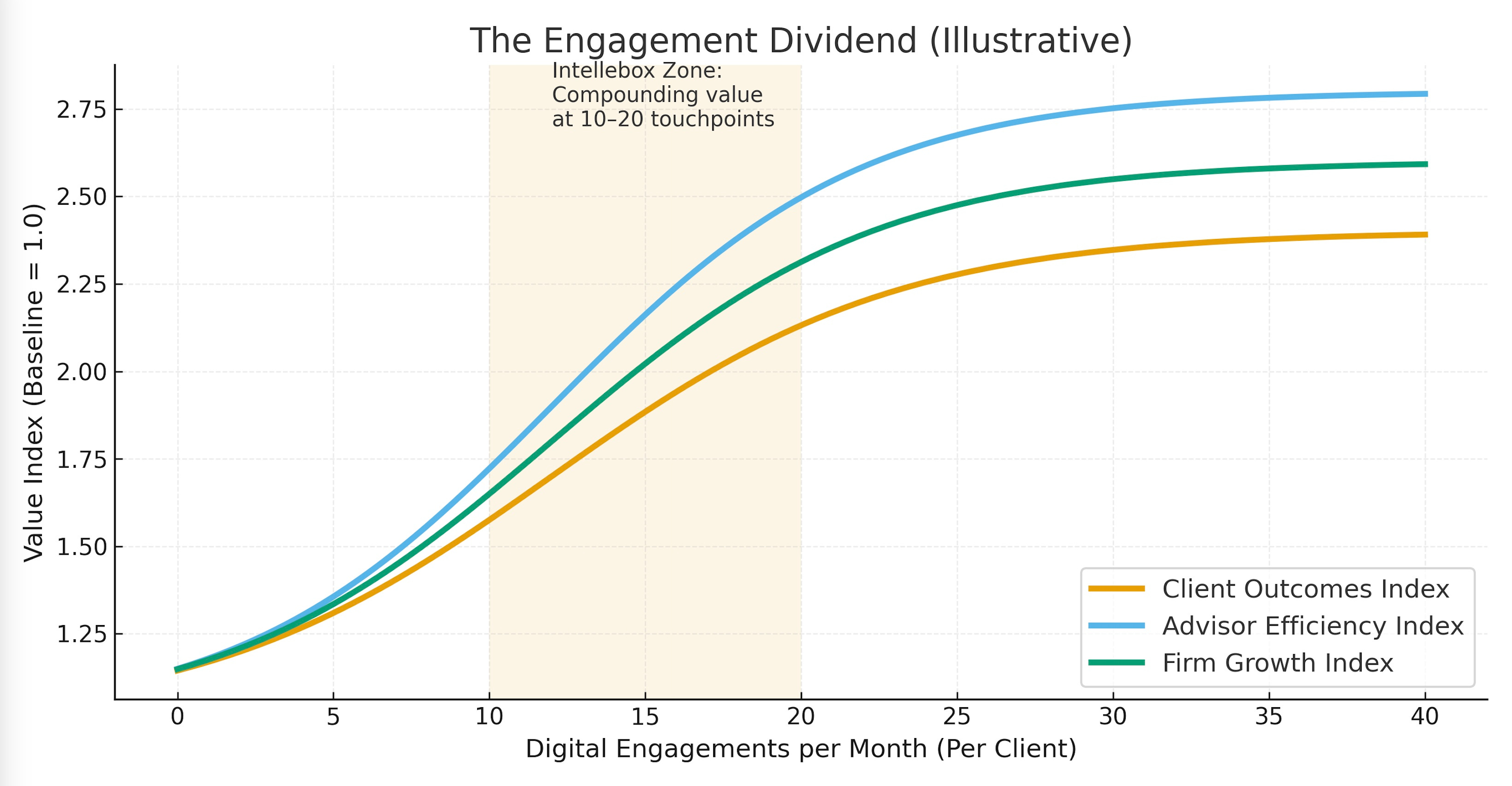
The Engagement Dividend (Illustrative) at 10–20 touchpoints. X-axis: Digital Engagements per Month (Per Client). Y-axis: Value Index. Lines: Client Outcomes Index (orange), Advisor Efficiency Index (blue), Firm Growth Index (green). The shaded “Intellebox Zone” highlights 2.25–2.75 compounded growth potential.
“The average brokerage client might check their Robinhood 200 times before they see their advisor once.
Imagine what happens when that same client sees you every day—your insights, your thinking, your voice. Not 200 times of noise. 20 times of meaning.” That’s the delta in emotional proximity. Advisors today touch clients digitally 2–3 times per month at best.
Robinhood, Coinbase, Mint? Dozens of micro-engagements per week—awareness, learning, dopamine.
That repetition builds trust by familiarity. Frequency of interaction is a primary goal of all businesses. But for some reason the wealth Industry has largely ignored this, especially from a digital perspective. A higher frequency of interaction with clients improves client experience, provides more insight about the client and also has the benefit of reducing churn.
Client churn is most often relational. According to Ensemble Practice, firms with the weakest engagement lose clients at twice the rate of their peers. In a business built on trust, silence is the costliest risk.
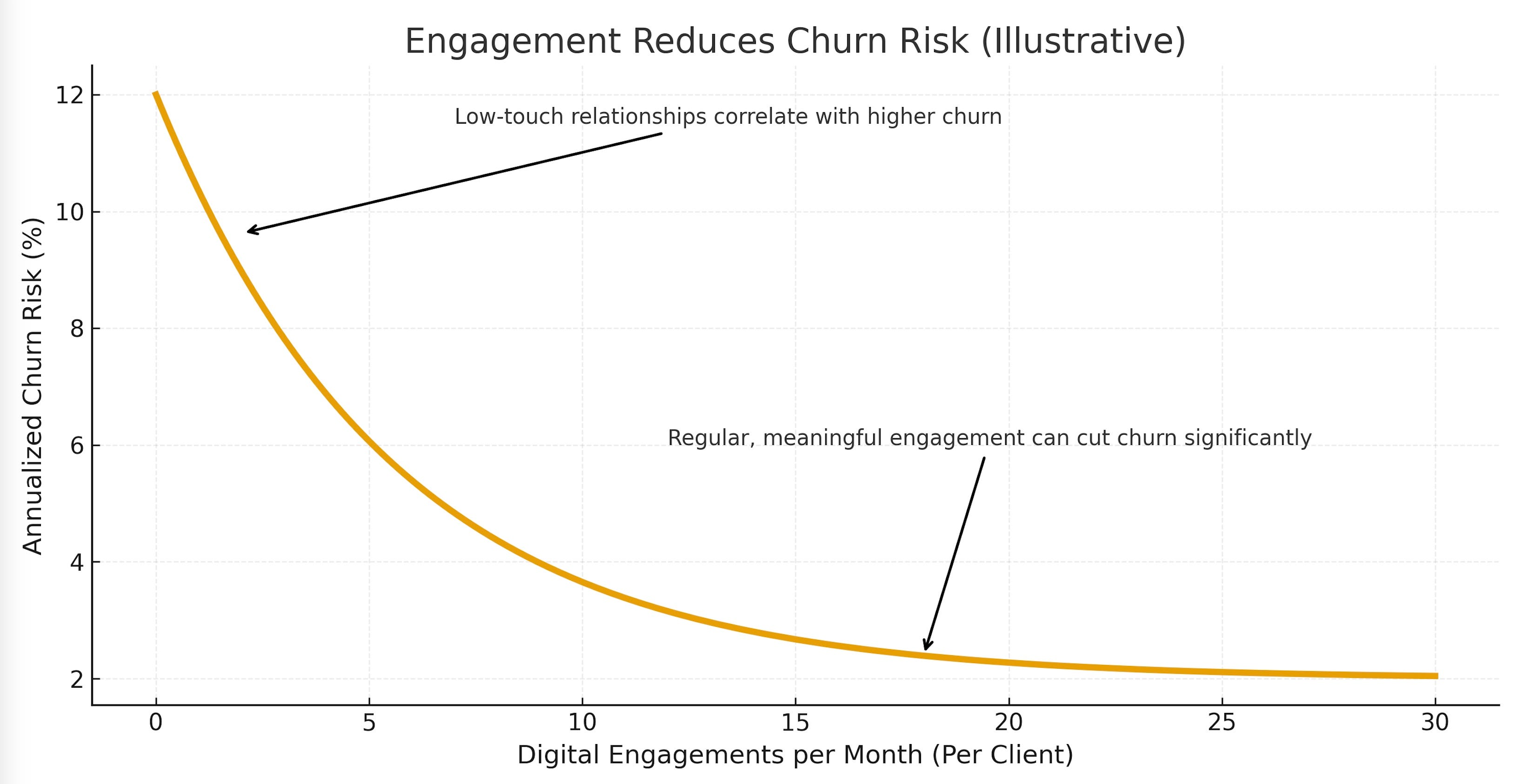
Figure above for illustrative purposes only
The Intractable Problem We Had to Solve: The Internet Solved the Time/Value Paradox—Wealth Management Hasn’t
Why No One Has Solved It? Because it’s hard. Painfully hard.
This isn’t e-commerce or social media. You can’t just “move fast and break things” when you’re managing generational wealth and regulated fiduciary relationships.
As of yet, no one from the outside has been able to solve this. Frankly, no one from the inside of the industry has either. Solving this means integrating deep domain expertise, compliance, client empathy, research, and real human psychology, and doing it in a way that actually builds trust, not erodes it. Most firms gave up before trying. Others are trying by slapping a chatbot onto a CRM and calling that innovation. I saw the need for an AI that learns and acts with human-like intent and intelligence. While automation is one piece of the puzzle, there is so much more to it. Automating certainly can capture the low hanging fruit and do it in a way where not much domain expertise is required, but it’s the more sophisticated solutions that make a difference. De novo activities and applications, multi Agent protocols and collaborations are major solutions that have not arrived on the scene yet. At Intellebox they have, and in aggregate these multiple capabilities will begin to look like intelligence. The way we see it….essentially we are building cognition.
Here’s the paradox we attacked head-on:The more successful an advisor becomes, the less available they are. That’s not a failure of effort — it’s a failure of architecture. Artificial Intelligence properly designed can solve this.
Our days are consumed by tasks that machines can do better: compliance, follow-ups, planning inputs, data synthesis. 80% of the job is process. Only 20% is wisdom. So we built a system that automates the 80%, so humans can amplify the 20%.That’s how we scale humanity.
First Principle: We don’t replace the advisor. We free them up for their highest value to their clients
Every advisor has uttered it: “If only I could clone myself.” We’ve built a business model where growth, income, and impact are handcuffed to the clock. Time doesn’t scale. Engagement does.
Consider the numbers. The industry faces a 100,000–110,000 advisor shortage by 2034, with 30–37% of current advisors retiring and only about 50,000 new ones entering the field. That’s a $100–110 billion capacity gap, right as demand surges from that generational shift. Firms can’t hire fast enough—skilled advisors cost $145,000–$300,000 annually, and margins erode under the pressure.
For intellectus, Intellebox.ai cracks this open by turning passive clients into active partners through scaled, intelligent engagement. We’re not talking generic newsletters; we’re delivering a platform where clients engage daily- sometimes more, with our ideas, suggestions, our market views, our rationale behind every move. This isn’t a data dump; it’s education wrapped in transparency, helping clients understand our strategies, thought leadership, and investment philosophies. It fosters trust without demanding more face time, freeing our advisors for what they do best: high-touch strategy.
The payoff? Exponential. Move a client from 2 touch points per month to 20 micro-engagements, and you could see a 3x lift in retention and wallet share. Referrals multiply. Growth accelerates. And for firms, it’s a game-changer: serve 5–10x more clients at 50–60% lower operational costs, all while automating 80% of routine tasks.
Look outside of our industry for examples.
Netflix didn’t win with more movies. It won with habit-forming interfaces that made content feel alive every day.
Amazon didn’t win with better inventory. It won with micro-conversions—one-click, personalized nudges, “you might like this.”
Robinhood didn’t win with better trades. It won with 15–25 digital touch points per month—small, frequent, dopamine-driven moments that build trust through familiarity.
Engagement is the surface area of trust.
Increase surface area → increase retention, cross-sell, lifetime value.
—McKinsey, Qualtrics, Watermark Consulting
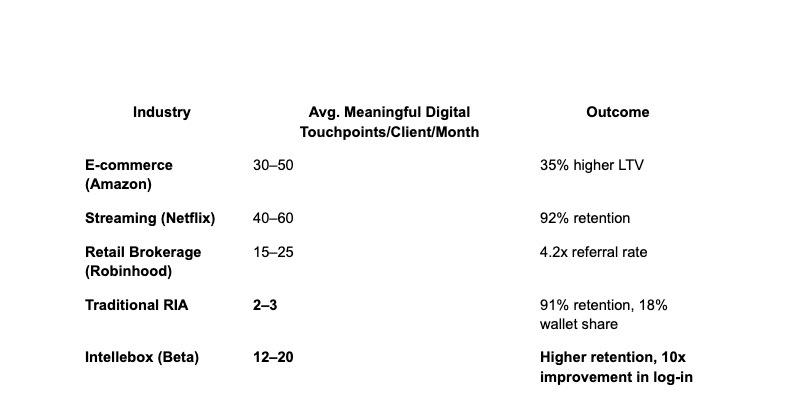
Sources: McKinsey Digital Sentiment Index, Forrester CX Report, J.D. Power Wealth Management Study, Intellebox early pilot data
Yet in wealth management, we still treat engagement like an afterthought.
This isn’t about matching Netflix or Robinhood’s dopamine loop. It’s about learning from its design truth: people build loyalty where they feel constant connection. Imagine pairing that behavioral reality with the depth of real fiduciary advice
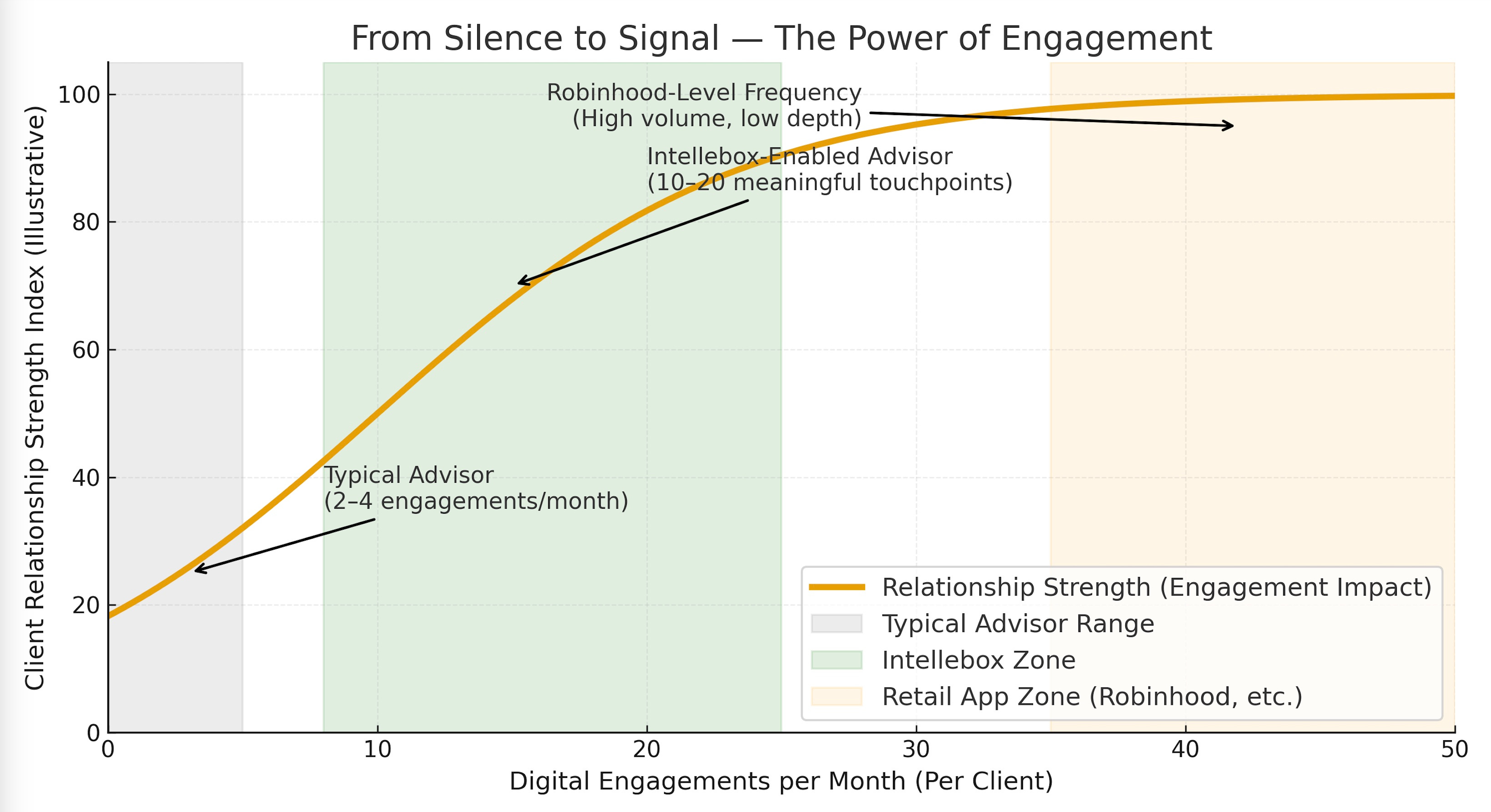
Figure above for illustrative purposes only
In every other industry, engagement is now a profit center. In ours, it’s still an accident. It’s time to measure it as a business KPI, because it is one
The Second Revolution
So we built Intellebox — not from a business plan, but from necessity.
The modern AI boom was born from the Transformer architecture — powered by Google’s TPUs and NVIDIA’s A100s — the foundation of today’s high-performance computing. I was fortunate to have a seat at the table during those early days through my board seat at Orbital Insight, one of the pioneering venture-backed AI companies.
The breakthroughs of 2020–21, AlphaFold’s mastery of Science & biology and GPT-3’s mastery of language, reshaped how I thought about what was possible for our industry. That’s when we began building, testing and iterating. Then came the moment that made it real: the Washington Post story about a Google engineer convinced LaMDA had come to life. It was a sign of how far we’d come — and how fast the frontier was moving.
When ChatGPT arrived later that year, the inflection was unmistakable. It felt like 1994-95 all over again — the way Netscape turned the internet from theory into lived experience by every day Americans. That was our spark. We accelerated development because it was clear what large language models and the new AI architecture could finally make possible. We just had to build it.
I asked myself: If we started wealth advisory today ~from first principles, how would we design it? It wouldn’t be static dashboards or quarterly reviews. It would be alive. It would engage. It would learn. It would finally give us the ability to scale the way other industries already had.
A living, breathing system that thinks, speaks, and engages like the humans behind it.
Agents that aren’t just tools assisting Advisors, but teammates. AI not as an accessory, but as the core nervous system of the entire firm.
This category does not yet exist in our industry. But that is what Intellebox is building: the first Agentic Client Engagement Platform. A new operating system for advice. We have much to do and to prove, but based on early feedback, we are clearly on the right path. We will be continuing to sprint as fast as we can to craft and accelerate this category.
First Principle: Presence is the new alpha
What makes Intellebox truly unique is our approach — we’ve built the platform from the client’s perspective but imbued with the domain expertise of the Advisor. By focusing on how investors engage, learn, and communicate, Intellebox enables a level of dialogue and understanding that hasn’t been possible before. While other AI systems rely on the same advisor-centric data that every firm already collects, Intellebox changes the game with an investor-centric engagement layer that opens new conversations and captures insights that have never before been accessible, organized, or utilized.
It’s a system where:
AI agents handle most of the repetitive advisory work — compliance, research, communication. This frees up advisors for the highest value actions, things such as strategy, understanding how the client thinks, asking the right questions to allow the systems to calculate risks, counseling clients on interfamily issues, generations constructs and best ideas. But the Agentic upside is far more…
Every client conversation, alert, or research update is contextual, personalized, and always on. It is timely to the clients and the Advisors. All managed inside of a cohesive Communications Hub that is also an optimal Compliance secure safe center.
We are building intelligence…learning into the system. The system learns, adapts, and acts with intent — not waiting for commands, but anticipating them. Growing in capability, accuracy and meaning as it scales…as you scale. If we can build a natural ability to learn effectively into the system, it will always be getting better and adding more value to the Client and the Advisor.
This is beyond automation. It’s augmentation — a way to multiply human presence instead of replacing it. It the advent of the Autonomous Advisor
From Independence to ….Intelligence
Intellectus was part of the first revolution — it redefined trust. Intellebox is the second — it redefines presence.
The first was about removing bias. The second is about removing friction. We’re not chasing efficiency; we’re engineering exponential empathy, where every client can feel your insight in real time. Inside Intellectus, Intellebox is already live. Clients are engaging 10x more often, with 2x higher confidence in decisions. We’re early, but proving that advice can be continuous, contextual, and human; all at once.
And we’re not stopping there. The early proof has given us conviction and momentum. To take this movement from one firm to an entire industry, we have a secret weapon in someone with deep industry expertise from the enterprise side, who knows how to scale revolutions: my Co-Founder, AJ De Rosa. AJ has spent his career turning high-growth startups into hyper-growth category leaders. He’s leading Intellebox to the market — deliberately, intelligently, and fast.
The interest has already been extraordinary, and we’re ramping new customers now. What began as an internal breakthrough is quickly becoming a platform others can build on.
Why This Matters Now
The simulation is upon us ;) — and with the advent of AI….it’s accelerating. With over $140 trillion in assets sitting inside RIA firms, we are now a very large industry. That’s nearly the size of the entire U.S. economy. And yet the way we engage those clients hasn’t fundamentally changed in forty years. The system was designed for a slower world — where investors checked markets monthly, and information moved by fax, not feed. But that world is gone.
The next generation of clients won’t wait for quarterly reviews or static portals. They live in a world of continuous feedback loops, where context updates by the minute and expectations never sleep. They want insight when it matters, not when it’s convenient.
At the same time, the industry itself is running out of people. By 2034, we’ll be short more than 100,000 advisors, even as client demand grows exponentially. The math doesn’t work. The old model can’t scale. Human scarcity is now a constraint on growth, a perfect set up for AI.
First Principle: When people become the bottleneck, intelligence becomes the infrastructure.
That’s why this moment matters. We’re standing on the edge of the second great transformation in wealth management — one that replaces human scarcity with AI abundance, machine intelligence, and episodic touch points with continuous presence and connection.
The first revolution was one which Intellectus saw early and capitalized upon, which solved for trust and alignment. It put advisors back on the same side of the table as their clients. The second, Intellebox a true Intellectus invention, solves engagement and scale. It ensures that human insight never goes dark and connection stays primary. It’s the difference between being an advisor and being a system of advice.
The Future Is Already Here
It had to exist. We’re not building for what’s next. We’re building for what’s here now and yes, long overdue. Advisors shouldn’t have to choose between growth and humanity. Clients shouldn’t have to choose between technology and trust. I’ve lived through every stage of this industry’s evolution, and I can say with confidence: the next decade won’t be won by scale alone, but by adaptive intelligence via AI. Firms that combine human trust with digital fluency will own the future. Intellebox was designed for exactly that.
The answer to my long standing question is…a commitment to innovation and Artificial Intelligence is the catalyst
We’re entering an Agentic future—where advisors are empowered by intelligent companions, not overwhelmed by technology. But this will require a commitment to innovation to capture the Next Gen, to build the scale that is there for the taking, to get smarter and stay ahead of the risks as well as see the fast moving opportunities… to serve our clients in a way that matches and even exceeds their expectations.
Intellebox makes this possible.
This isn’t theory — it’s live inside Intellectus right now and in the process of ramping to additional customers. It’s already proving that advisors can scale their minds without losing their soul — that intelligence and empathy can coexist at exponential scale.
I built Intellectus to liberate the advisor and magnify the client relationships.
It’s already proving that advisors can scale their minds without losing their humanity; that clients can feel connected without compromise; and that the firm of the future can be simultaneously personal, compliant, infinitely scalable and even…autonomous.
I didn’t build Intellebox for myself — I built it for my clients who wanted more of us. Clients who are smart enough to know that the more they know of what we, their Advisors are doing, the better their outcomes. I built this so that our clients could finally get the benefits of scale that technology, and specifically AI is bringing to every other industry. I built Intellebox.ai because it is AI that will bring the most value out of the Advisory relationship to the client!
For clients who expect their advisors to move at the speed of their ideas.
For advisors who want to multiply their presence without losing their purpose.
For firms that understand that the future of wealth isn’t about managing assets — it’s about managing relationships through engagement.
Intellebox gives them that power. It’s not an upgrade. It’s a new operating system for advice.
We didn’t automate advice. We brought intelligence to it and amplified that!.
Intellebox is the first Agentic Client Engagement Platform — a new operating system for wealth management, born from the conviction that the next revolution in our industry won’t come from a new product, but from an entirely new platform.
The industry will follow again — because it has to. Of that $144 trillion of AUM? If engagement improves outcomes by even one percent, that’s $1.4 trillion of client value unlocked, and billions in enterprise value preserved.
We built what didn’t exist, and we built it first….for the future of Advice!
Learn more at www.intellebox.com
Follow the revolution in Agentic AI.
If this resonates, reply. If you’re a client, log in and tell me what you think. If you’re an RIA, and want to chat, reply ‘PILOT’. If you’re just curious—subscribe.
This isn’t about replacing advisors.It’s about freeing them to be more human.
……………
Finally, if you are running another form of Advisory, Research or Investment business where you need to up your engagement game with your clients/audience/L.P’s or investors, ping us, there’s more to discuss…
David J. La Placa
Founder & CEO, Intellectus Partners
Creator, Intellebox
Charts: Intellebox pilot data (12 firms, $150M–$2B AUM), McKinsey, Forrester, J.D. Power, Cerulli. Full sources on request.
David J. La Placa is Founder & CEO of Intellectus Partners. Thoughts? Reply below or DM me on X @davidlaplaca. For RIA leaders interested in a demo, hit reply—let’s chat scale.